Everyday Money · Comparing payment methods
Cash or card: Which is really better for everyday payments?
The bill arrives: reach for coins or tap a card? Convenience does not automatically mean lower costs, greater privacy or better resilience. We compare everyday payments in the euro area, with practical context for Austria. The focus is cash and debit or credit cards; a card stored on a phone usually still uses card infrastructure. Bank transfers, cryptocurrencies and a potential digital euro raise separate questions.
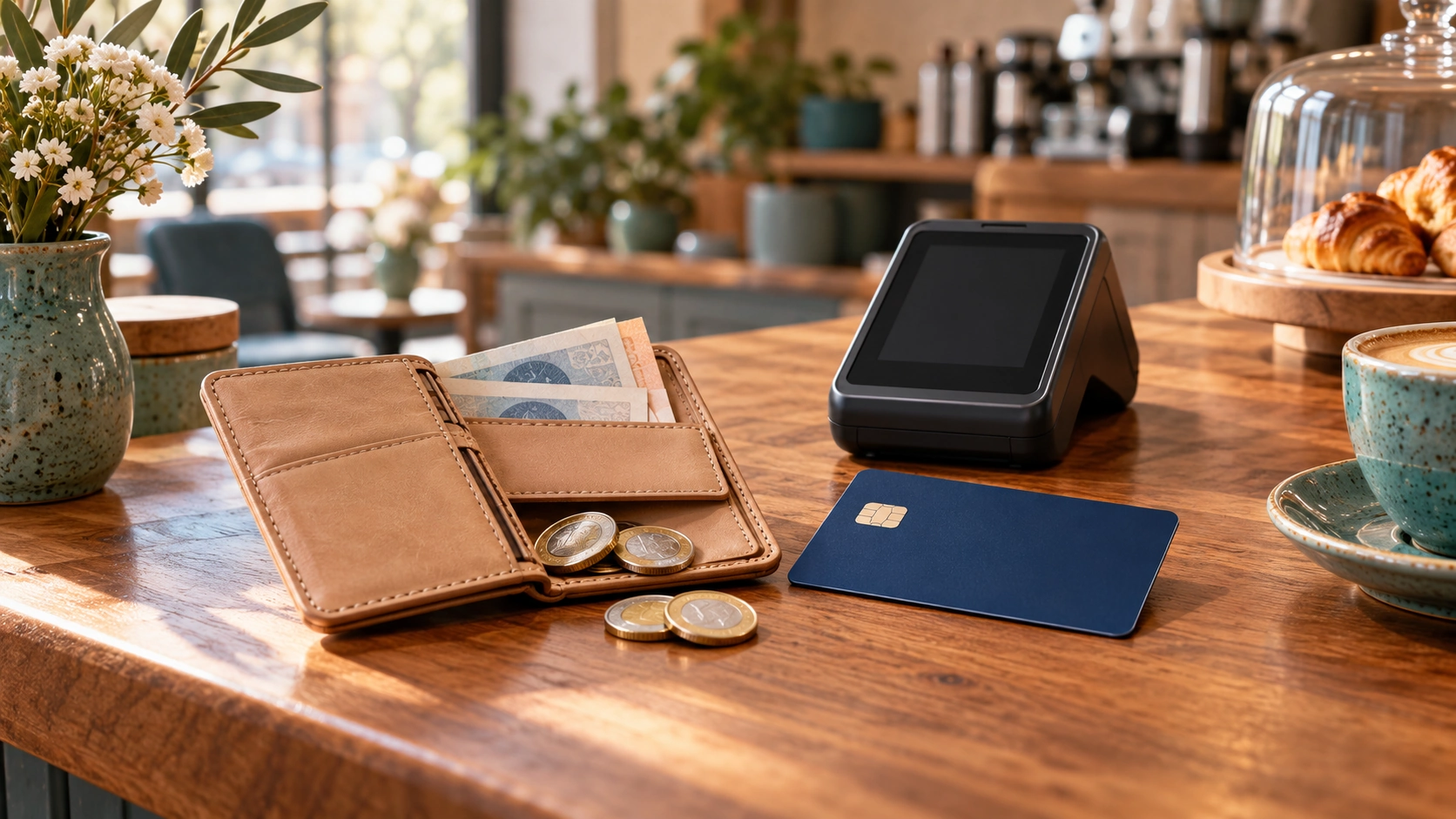
Cash has clear strengths for privacy at the point of payment and as a backup during technical failures. Cards make many purchases easier and create traceable account entries, but replace neither a budget nor functioning payment infrastructure. For most everyday situations, preserving choice makes more sense than declaring a universal winner; the strength of the evidence differs by criterion.
The strongest arguments for cash
Privacy without a card transaction record
A cash payment does not require a payment provider to process the individual purchase through a card account. That is a structural privacy advantage also highlighted by the ECB. It does not make the entire shopping trip invisible: using a personalised loyalty card, for example, leaves other traces regardless of how you pay. The relevant question is which data are generated and who receives them, rather than a promise of complete anonymity.
A visible boundary for a daily budget
Setting aside a fixed amount of cash can create a readily understood spending limit. Research supports a small average difference towards greater spending with cashless methods: a 2024 meta-analysis combines 392 effect sizes from 71 papers. However, it covers different situations, including hypothetical purchase decisions. That is a reason to observe your own habits, not proof that everybody saves with cash or automatically incurs less debt.
A different kind of backup
Handing over banknotes and coins needs neither a charged battery nor network access. Cash helped during Spain’s power cut on 28 April 2025, when electronic payments and some ATMs failed, as the Spanish central bank describes in its 2026 retrospective. Cash cannot fix a blackout, though: shops still need stock, workable procedures and sometimes change. Waiting until a power cut to withdraw money is not a dependable fallback.
Access without a digital hurdle
Paying directly with cash requires no app or smartphone authorisation. That matters to people who cannot or do not want to use digital methods. Cash must first be available, however: trips to an ATM, possible fees and merchant acceptance belong in the comparison. Declining use therefore no more justifies removing cash than a preference for cash justifies excluding digital options.
The strongest arguments for cards
Convenience without carrying larger sums
Cards and phones can remove the need to find change or visit an ATM. Cards are also directly usable online. In SPACE 2024, respondents chiefly associated cards with carrying less cash, speed and ease. These are reported perceptions, not measurements proving that every card payment is faster in every setting. Acceptance and functioning technology still matter.
Account entries make spending reviewable
Card transactions can be checked in an account or statement; the OeNB recommends reviewing entries and receipts. This can help people keep track of household spending. A list alone does not impose a limit, however. You must actually review it and consider whether payment is charged immediately or later. Our assessment is that deliberately using a transaction record can counterbalance the advantages of a cash budget, but does not establish universal superiority for saving.
A lost card can be blocked
Losing a card does not mean the entire account balance has physically disappeared like lost banknotes. Cards can be blocked, and loss or theft should prompt immediate action. That does not make them risk-free: stolen card details and unauthorised transactions remain real risks. Refunds and liability depend on the circumstances; we offer no blanket money-back guarantee.
Some card schemes can be economical for merchants
Cash takes staff time to count, store and obtain. The Bundesbank’s 2025 German merchant study nevertheless found no universal card victory: cash was cheapest per transaction, while Germany’s girocard was cheapest relative to turnover. International debit and credit cards were more costly than the respective cheapest option on both measures. This is not an Austrian tariff: schemes, contracts, purchase amounts and business size need a specific comparison.
Fact-check: What does the evidence actually support?
SPACE 2024 reports that cash accounted for 52% and cards for 39% of payments at physical points of sale in the euro area. By value, cards led with 45%, against 39% for cash. Meanwhile, 55% preferred cards or other cashless methods. These are different questions and denominators. The study draws on diaries and surveys collected in 2023/2024, not a census of all payments in 2026.
The meta-analysis finds a small positive average effect of cashless payment on spending outcomes: Hedges’ g = 0.135. This explicitly does not mean 13.5% greater spending. After removing two influential outliers, the analysis includes 392 effect sizes from 71 papers. Results vary considerably and combine willingness to pay with real and hypothetical purchases, among other measures. They cannot be converted into a personal annual saving or a general effect on indebtedness.
The corrected December 2025 Bundesbank study reports average total costs of EUR 0.43 per cash payment and EUR 0.60 per girocard payment. Relative to turnover, the figures were 2.3% and 0.8%. These include more than transaction fees. The study uses timing observations of around 13,000 payments at 15 outlets and 268 usable business questionnaires; it is neither an Austrian price list nor a comparison of identical shopping baskets.
Cash can be handed over without electronic authorisation. Spain’s blackout demonstrates the practical importance of this property, but does not prove that cash guarantees uninterrupted supply during every outage. ATMs and electronic tills can fail too. A central-bank retrospective is also not a controlled study establishing a numerical advantage across all crises.
Euro cash is legal tender. This should not be taken to mean that every merchant must accept every proposed cash payment in all circumstances. Austria’s economics ministry points to possible contractual exclusions and says that their validity, particularly through standard terms or a notice in a shop, is not conclusively settled. Nor does card popularity create a general obligation to accept cards. This account was checked against official information on 7 November 2026.
The sources provide no single ranking combining privacy, convenience, costs, inclusion and emergency preparedness. Some findings concern technical properties, others survey responses or personal values. Someone with difficult access to cash faces different costs from a person who passes an ATM every day. Merchant costs are also different from customers’ fees or time costs.
Our assessment
Cash is particularly valuable for privacy in individual payments and as a reserve independent of electronic authorisation. Cards offer clear practical advantages for convenience and a reviewable transaction history. For saving and costs, however, the evidence does not support a simple slogan: the spending effect is small and context-dependent, while merchant costs depend on the scheme and measure used. Our practical inference is therefore a deliberate combination: use an appropriate method, track your budget and avoid relying entirely on a single technical payment channel. How much cash makes sense depends on your needs and safe storage; these studies do not establish a universal amount. Public debate should protect choice and functioning infrastructure rather than portraying cash users as backward or card users as careless.
Sources and references
Editorial source and language recheck: 7 November 2026. Article approved by the operator on 7 November 2026; separate publication checks remain open. SPACE 2024 is a descriptive diary/survey study; the ECB overview announces the next edition for 2026 but did not yet link a new results edition when checked. The original meta-analysis was read as a publisher PDF hosted by a cash-supporting third-party mirror, whose views are not an additional source of evidence. The Bundesbank version includes December 2025 corrections and older fieldwork. Several central-bank sources belong to the Eurosystem and should not be counted as independent confirmations. Legal statements are restricted to the identified official explanations; individual disputes need separate assessment. No third-party video transcripts, invented tariff offers or personal savings promises.
- EZB / ECB (2024): Study on the payment attitudes of consumers in the euro area (SPACE 2024)Zahlungstagebücher und Befragung / Payment diaries and survey
- EZB / ECB: The role of cashInstitutionelle Erklärung zu Bargeldeigenschaften / Institutional explanation of cash functions
- Schomburgk, Belli & Hoffmann (2024): Less cash, more splash? A meta-analysis on the cashless effectOriginaler Verlagsartikel auf Drittanbieter-Mirror / Original publisher article on third-party mirror
- Ego, Knümann & Korella / Deutsche Bundesbank (2025): Kosten von Zahlungsmitteln im Einzelhandel, korrigierte Fassung Dezember 2025Originalstudie zu Händlerkosten in Deutschland / Original German merchant-cost study
- Banco de España (27.04.2026): How do we pay when the power goes out? Spain’s blackout experienceRückblick der spanischen Zentralbank / Central-bank retrospective
- Oesterreichische Nationalbank: Debit- und KreditkarteOffizielle Finanzbildungsinformation / Official financial education
- Europäische Union / European Union: Official EU currency, aktualisiert / updated 12.01.2026Amtliche Erläuterung des Rechtsrahmens / Official explanation of legal framework
- BMWET Österreich: Sicher im Falle eines Blackouts, rechtliche Fragen zur ZahlungAmtliche österreichische Praxishinweise / Official Austrian practical guidance