Energy & Climate · Costs, grids and CO₂
Nuclear power or renewables: What can deliver Europe’s electricity?
On a dark, still winter evening, electricity must be available. On a sunny summer day, the grid must also be able to take it. That is where the serious debate about nuclear power and renewables begins. We examine Europe’s electricity supply towards mid-century: existing reactors, new power plants, and the networks, storage and demand that connect them. Here, renewables means mainly wind and solar photovoltaics; hydropower, geothermal and other sources have different characteristics. Electricity is only part of total energy use.
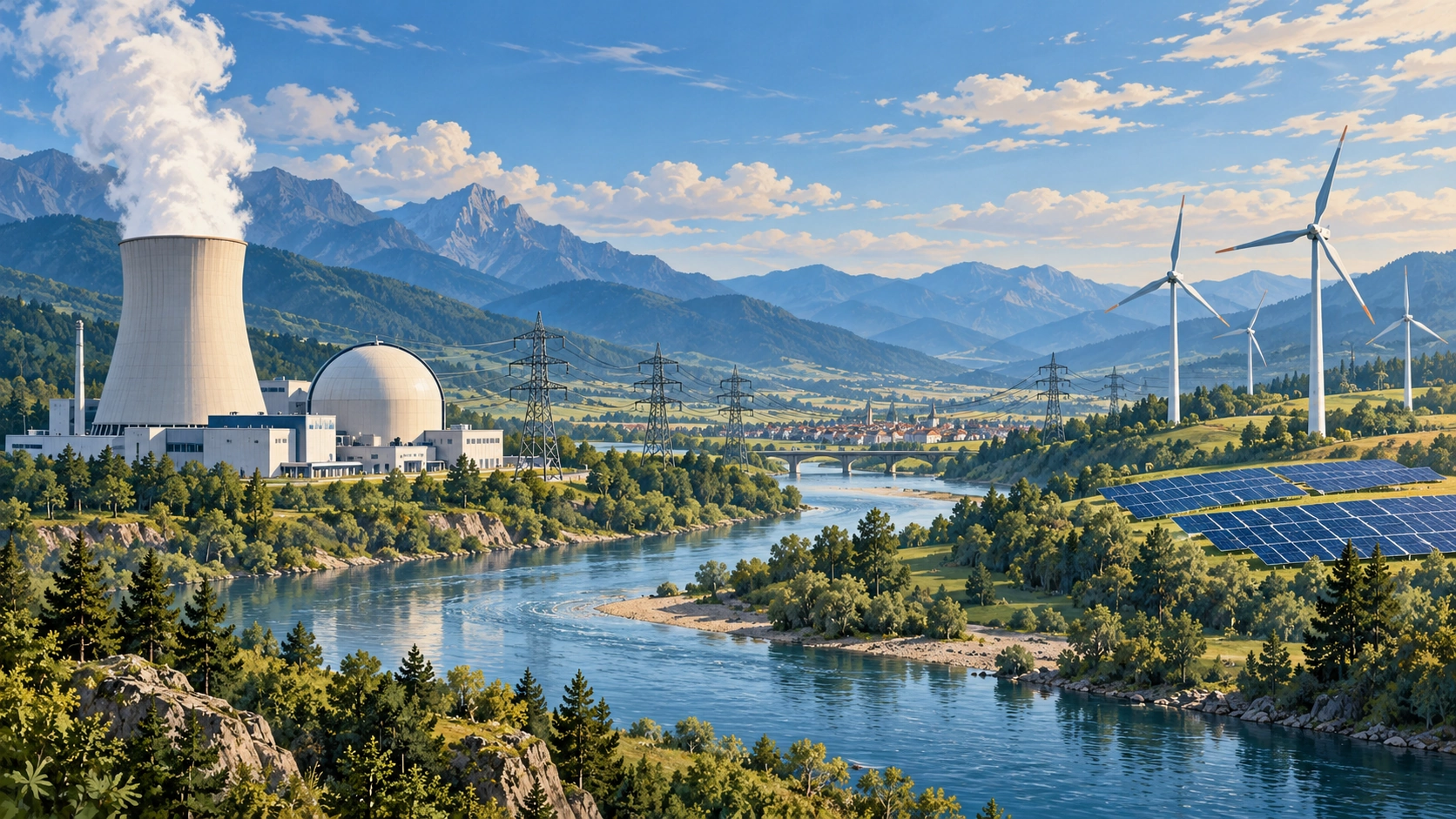
Nuclear, wind and solar can all contribute to low-emissions electricity, with different strengths and risks. The evidence supports substantial wind and solar expansion, but establishes neither cost-free reliability nor a universally cheapest mix. Extending a reactor’s life when it meets safety requirements is a different decision from building a new one.
The case for a nuclear contribution
Power when wind and sunshine are scarce
Nuclear provides dispatchable, low-emissions generation and can cover periods of weak wind or sunshine. This has system value beyond the price of an individual kilowatt-hour. Availability is nevertheless not guaranteed: maintenance, technical outages and cooling-water constraints at some sites must be planned for. A system that includes reactors still needs reserves and a robust grid.
Existing plants can be valuable assets
Life extension uses infrastructure already built, but requires safety assessments, any necessary upgrades and arrangements for waste. The IEA’s 2022 scenarios identified extensions as a competitive low-emissions option. That is neither a current price quote nor operating approval for every reactor. Our inference is that the value of continuing a particular plant should be assessed separately from the risks of a new megaproject.
A mix can reduce whole-system costs
RTE compared six French generation scenarios in 2021. Under its assumptions at the time, combinations of new reactors and renewables had lower total costs than certain entirely renewable alternatives. Networks and flexibility were included. This is a serious argument for complementarity, but not a current Europe-wide price: financing, technology costs and France’s existing fleet shape the result.
A relatively small land footprint
The IPCC describes nuclear power as requiring relatively little land and low quantities of important bulk materials per unit of energy generated. That can be an advantage in densely populated regions. Consistent boundaries matter: the whole area of a wind farm is not sealed ground and can partly remain in agricultural use; fuel extraction and waste management also belong in the assessment. Land use alone cannot settle a siting decision.
The case for prioritising renewables
Competitive new electricity from wind and solar
For plants commissioned in 2025, IRENA reports global capacity-weighted levelised costs of USD 33 per megawatt-hour for onshore wind and USD 44 for utility-scale solar PV, in 2025 dollars. These are lifetime generation costs, not Austrian household tariffs. They demonstrate competitive generation, but do not price an entire round-the-clock electricity system and are not a direct comparison with new nuclear plants.
Expansion through many separate projects
Wind and solar can be developed incrementally. The IEA’s 2026 analysis gives typical timelines for new wind and solar projects of one to five years, compared with five to fifteen for new grid infrastructure. Fast plant construction therefore does not guarantee a fast connection. Large new reactors, meanwhile, face substantial capital requirements and documented delay risks. Which investment can replace fossil electricity in time also depends on permits, grid capacity and supply chains.
Reliability can be planned without new reactors
High wind and solar shares require a coordinated system of networks, storage, flexible consumers and adequately available complementary generation. The IPCC assessment supports the technical feasibility of very high renewable shares under suitable conditions. That does not replace location-specific planning. Batteries can shift energy within a day, for example; their power rating in megawatts says little about how long they can cover a lull without their duration and state of charge.
New reactors create long-term obligations
Nuclear requires safety oversight, decommissioning and strictly regulated radioactive waste disposal. Rare major accidents remain a relevant risk; the IPCC also finds that improved reactor designs reduce it. Wind and solar avoid these particular obligations but have their own effects on landscapes, ecosystems and material supply chains. A fair assessment describes these different consequences rather than treating all environmental risks as equivalent.
Fact-check: What does the evidence actually support?
The IPCC’s scientific assessment identifies nuclear, alongside wind and solar, as a low-emissions option. Construction, raw material extraction and other upstream processes still matter. It is therefore untenable to claim that only one side can contribute to climate mitigation. We give no universal ranking in grams of CO₂ per kilowatt-hour because locations and assessment boundaries differ.
IRENA’s USD 33 and USD 44 per megawatt-hour figures are global averages for new plants. RTE instead models generation, networks and flexibility across a national system. These measures cannot simply be set against each other. Annual energy and dependable capacity also differ: a balanced annual energy account does not prove that supply meets demand every hour.
IRENA reports modelled costs below USD 85 per megawatt-hour at high-quality sites in 2025 for solar-battery systems with 95% reliability. The cost measure includes the additional storage and generation capacity assumed by the model; it is not the price of solar generation alone. That modelling condition is not a guarantee of uninterrupted supply every hour or proof that every European winter can be covered. The progress matters; a complete supply solution must also cover the remaining gaps.
RTE’s French comparison dates from 2021 and includes cost calculations extending to 2060. Its variants show the importance of financing and flexibility costs. We use it to explain system comparison, not as a current investment recommendation. Expected economies from producing small modular reactors in series are likewise scenarios in the IEA analysis, not established European mass-production prices.
Section 2 of Austria’s Federal Constitutional Act for a Nuclear-Free Austria prohibits constructing facilities for energy generation through nuclear fission in the country and commissioning such facilities if they already exist. This is separate from the technical comparison of European systems. It does not imply that physical electricity flows across the interconnected grid can be sorted by generation type at the border. Law checked on 7 November 2026.
Averages and scenarios establish neither a reliable price for a particular household nor a guaranteed completion date. Specific offers, financing, grid access and credible availability assumptions are needed. Uncertainty does not make all options equal: documented cost and schedule risks should carry appropriate weight in decisions.
Our assessment
A simple either-or hides three decisions: which safe existing assets remain available, which new generation can be built in time at acceptable cost, and what else the electricity system needs. Our assessment is that Europe should give high priority to wind and solar expansion because of their cost advantages and scope for deployment, alongside networks and flexibility. In countries with suitable reactors, continued operation can help displace fossil generation. New nuclear projects must instead be judged against realistic schedules, financing, safety and waste obligations. A proposed reactor should be compared with a complete alternative system, including costs and outage risks. An all-renewable strategy must be equally specific about financing and delivering supply through prolonged shortages. Austria’s constitutional prohibition adds a separate constraint. An advantage in an international model does not override it.
Sources and references
Editorial source and language recheck: 7 November 2026. Article approved by the operator on 7 November 2026; separate publication checks remain open. Eight references from five institutions; four IEA references are not four independent confirmations. The IPCC assesses literature, IRENA compiles cost data and has a renewable-promotion mandate, and RTE is a French transmission operator modelling systems. Scenarios are neither experiments nor guaranteed predictions. Relevant original passages were checked, including the 2026 IRENA report and IPCC chapter as PDFs; older findings retain their dates. No original electricity-market simulation, invented project tariffs or third-party video transcripts. Conclusions are editorial assessments of the cited evidence.
- IPCC (2022): AR6 WGIII, Chapter 6 – Energy SystemsWissenschaftliche Literaturbewertung / Scientific assessment
- IRENA (2026): Renewable power generation costs in 2025Originaler Kostenbericht, Datenjahr 2025 / Original cost report, 2025 data
- IEA (2025): The Path to a New Era for Nuclear Energy – Executive SummaryMarkt- und Szenarioanalyse / Market and scenario analysis
- IEA (2026): Electricity 2026 – GridsNetzanalyse / Grid analysis
- IEA (2026): Electricity 2026 – FlexibilityFlexibilitätsanalyse / Flexibility analysis
- RTE (2021): Energy Pathways to 2050 – Key resultsFranzösische Systemmodellierung, Oktober 2021 / French system modelling, October 2021
- IEA (2022): Nuclear Power and Secure Energy Transitions – Executive summarySzenariobasierte Bestandsanlagenanalyse / Scenario-based existing-fleet analysis
- RIS: Bundesverfassungsgesetz für ein atomfreies Österreich, § 2Amtliche konsolidierte Rechtsquelle / Official consolidated law